Saturday, July 12, 2014

Review of Saints Behaving Badly

Book #25. Saints Behaving Badly, by Thomas J. Craughwell. Hardcover. 

The cover promises to tell the stories of “cutthroats, crooks, trollops, con men and devil worshippers who became saints.”

I knew the stories of many of these saints, including Augustine, Patrick, and Ignatius. But there were many more obscure saints and stories that I did not know. The story of St. Moses the Ethiopian, a violent gang leader in the 300s who later embraced the life of fasting and prayer after seeking shelter with a community of monks, was unknown to me. Also the biography of St. Alipius, a student of the Augustine (another infamous and notorious sinner turned saint), was "obsessed with blood sports" and all types of gambling. 

Balancing the humor inherent in some of these stories with the proper tone of reverence is not easy. But Craughwell does manage to accomplish this, with each of these small (4 to 10 pages) vignettes demonstrating his basic point that a saint is made and not born, and that nobody is beyond the reach of the grace of God.

Craughwell set out to present a readable, entertaining, and inspiring book of saint stories. And with those as his marching orders, I’d say he succeeded.

Thursday, July 10, 2014

Podcast Marathon

Summer vacation + recovering from cataract surgery = lots of time to listen to podcasts. Here is what I listened to yesterday:

Strangers & Aliens #131 -- Discussion of Terminators: Age of Extinction. The general consensus was that it was not a good movie, but still may have been the best one so far of the series. Also an interesting discussion of whether toy-based movies whould be made for kids or if it is okay that they are made for adults.

Vault of Startling Monster Horror Tales of Terror #15 -- I am working my way through the back catalog of this horror movie podcast. This episode featured discussion of the John Carpenter movie "Ghosts of Mars."

Superman in the Bronze Age  #110 -- Charlie Neimeyer talked about Superman #333. 

DH Unplugged #231 -- I learned bunches listening to this "mail bag grab bag" episode.  

 The Babble On Project #054 -- A terrific re-watch podcast of the terrific TV show Babylon 5. This episode went in-depth on the two Season 5 episodes "The Corps is Mother, The Corps if Father," and "Meditations of the Abyss." I didn't quite finish up this 3.5+ hour long episode. 

Saturday, July 5, 2014

Review of Justice League Dark, volumes 2 & 3

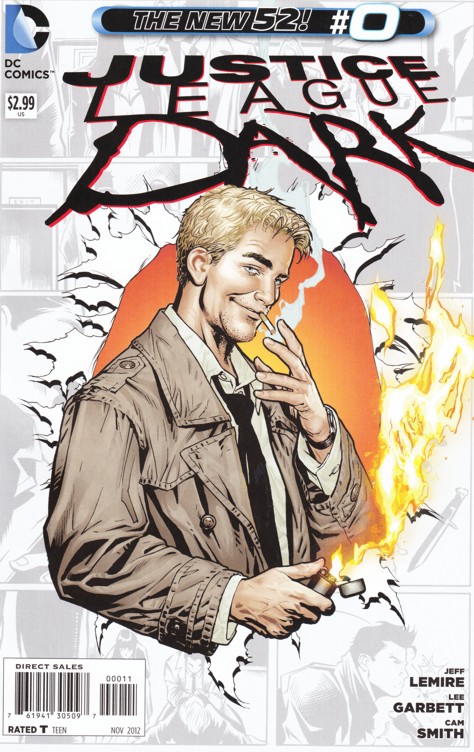
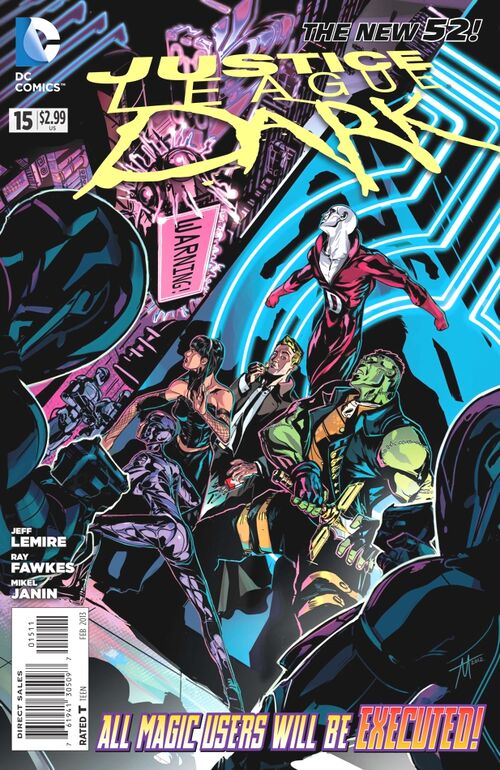
Book 24. Justice League Dark, volume 2 (The Books of Magic) and 3 (The Death of Magic), graphic novel containing issues 0, 7-21, and Annual 1. Written by Jeff Lemire, with art by Ray Fawkes, Mikek Janín, and others.

These issues begin with Zatanna and John Constantine tracking down the 4 mythical Books of Magic – this has been a lifelong quest for Constantine. Steve Trevor has tasked Constantine with the job, in exchange for time in The Black Room, the US’ secret stash of magical artifacts. Along with Deadman and the mysterious Black Orchid, and a little help from Madame Xanadu, the quest is undertaken.

We learn that the “big bad” of the arc is in fact someone from Constantine’s and Zatanna’s past, which is a story told as the Issue #0 origin story. This was an example of the episode #0 being both a good story in itself, while also tying into the story being told at the time.

Lemire includes the acrobat past of Deadman in intriguing ways, which was a nice take on a character I’ve always liked. One of my “blind spots” I comics is a lack of familiarity with the “old 52” version of John Constantine. So I admit that I am not burdened by expectations for the character – but I liked the character’s attitude. 

In the second arc, the existence of magic is threatened. This is a common trope in fantasy novels, but Lemire handles it well. There is a nice segment of issues, where the character’s fundamental aspects disappear. Deadman is alive, Xanadu is aging quickly, and Constantine can no longer lie. 

Over this long run of issues, appearances are made by Frankenstein, Agent of S.H.A.D.E., Amethyst, and Andrew Bennett from I, Vampire. I appreciate Lemire pulling in characters from all over the DC magical landscape. He also puts to good use both the House of Mystery and the House of Secrets. 

In general, I have found the “Dark Line” to be among the most consistently enjoyable books in the New 52.


Tuesday, July 1, 2014

June Reading List

23. The Girl Who Kicked the Hornet's Nest (ua), by Steig Larsson
22. Identical (ua), by  Scott Turow
21. The Athena Project (ua), by Brad Thor


Earlier in the year:
20. The Divine Hours: Prayers for Springtime (pb), edited by Phyllis Tickle
19. Billion Dollar Batman (pb), by Bruce Scivally
18. Wonder Woman: Iron (gn), by Brian Azzarello, Cliff Chiang and others
17. The Innocent (ua), by David Baldacci
16. Song of the Quarkbeast (ua), by Jasper Fforde
15. Uncle Scrooge: Only a Poor Old Man (gn), by Carl Banks
14. Doom's Day, Book #1: Rampage (pb), by Danny Fingeroth and Eric Fein
13. The Guild of the Cowry Catchers: Book 5 (ua), by Abigail Hilton
12. Aquaman: The Others (gn), by Geoff Johns, Ivan Reis, and Joe Prado
11. Doing Hard Time (ua), by Stuart Woods
10. Star Wars: Scoundrels (ua), by Timothy Zahn
  9. Shadow Ops: Control Point (ua), by Myke Cole
  8. Little Black Sheep (Nook), by Ashley Cleveland
  7. The Last Dragonslayer (ua), by Jasper Fforde
 6. Before Watchmen: Comedian & Rorschach, by Brian Azzarello, J.G. Jones, and Le Bermejo
 5. Inferno Revealed (hc), by Deborah Parker and Mark Parker
 4. The Gearheart (ua), by Alex White
 3. The Great Fables Crossover (gn), by Bill Willingham, et. al.
 2. Silent Partner (pb), by Terrence King
 1. His Last Bow (ua), by Sir Arthur Conan Doyle

Sunday, June 29, 2014

Review of The Girl Who Kicked The Hornet's Nest

Book #23. The Girl Who Kicked The Hornet's Nest, by Stieg Larsson. Unabridged audio.

The last book in the “Millennium Trilogy,” this novel deals with the plot and character consequences of the first two novels. This novel turns into a police procedural, a spy novel, and then a legal thriller. Lisbeth finds that she has to testify in court, and then later has to accept the responsibilities that accompany legal adulthood in Sweden. These situations take her on an interesting journey.

The parts of this novel not involving Salander are less compelling. We have action taking place at two publishing concerns in this novel, and the novel drags in those places. And the same complaint I had about Mikael Blomkvist in the prior novels, that he is a wish-fulfillment “Mary Sue” for the author, are as strong as ever here. The virtuous journalist (Larsson was a journalist) finds himself desired by every woman he comes across, who willingly and regularly offer themselves up to him, with no questions asked and no consequences.

But the novel moves at a brisk pace, and the tension that arises in the last third of the novel is worth any slow points and other issues I had along the way. And the subplot of corruption in the intelligence service brought a nice second plot to accompany the strong Salander plot.

There were rumors floating a few years ago of the possibility of at least a half-dozen sequels that were in various stages, based on notes and drafts found after Larsson’s death. I hope that those books never reach publication, as the novels in the current “Millennium Trilogy” hold together as a completed work.

Endings are hard, and all things considered, this ending was quite satisfactory.

Source: public library

Tuesday, June 24, 2014

Review of Identical

Book #22. Identical, by Scott Turow. Unabridged audio.

I have read nearly all of Turow's novels (including Innocent, reviewed here), and have enjoyed most of them.

Taking place again in the fictional Kindle County, this book involves a set of identical twins, one of whom is just out prison after a 25-year sentence, after confessing to the murder of a family friend.

A quarter-century later, the father of the murder victim believes (rightly as it turns out) that the story is not true, and that perhaps the wrong brother served the sentence. And as the novel unfolds, we learn that the crime may not have been committed in quite the way that anyone imagined. There are family and political dramas at work as subtext to the story, as well.

The advances in the science of detection serve as a nice backdrop to the story, as the changes from fingerprinting to DNA mean that the identical twins may not be as identical as was once thought.

There were some stereotypes among the mostly Greek-American cast of characters, but none of these traits seemed too out of line. In terms of what really happened, and who the real perpetrator of the crime was, I was in the dark until more than halfway through the book. At that point, the political aspects of the book (there is a race for Mayor taking place, and a gubernatorial election is part of the mystery's backstory) came to the forefront, and knowing Turow's affiliations, it was pretty clear who the murderer would end up being.

The characters are well-drawn, and the portrayal of the relationship between the twins was one of the strengths of the novel.

source: public library

Thursday, June 19, 2014

Review of All-Star Western 0, 17 & 18


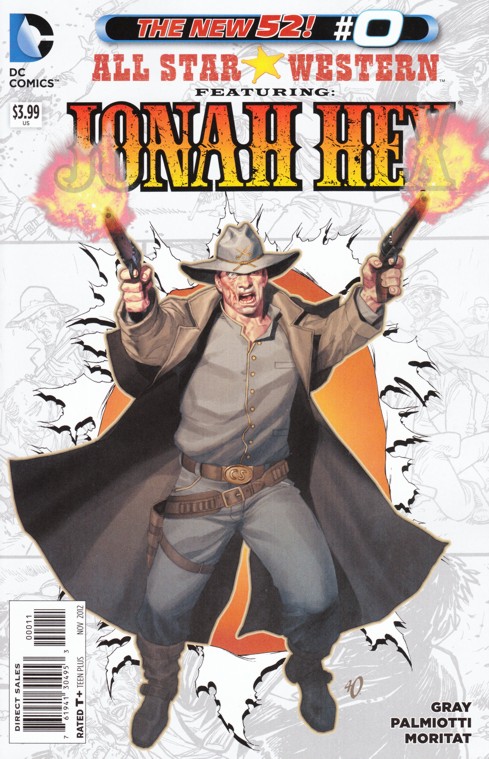
All-Star Western, issues 0, 17, & 18. Written by Justin Gray & Jimmy Palmiotti, with art by Moritat. DC Comics, cover-dated Sept 2012, April 2013 & May 2013.

The “origin story” of the Zero issue gives us a more fully-formed version of Jonah Hex’s childhood than has been seen in other versions of the character. The answer to the question of how he got his scars is both touching and revealing. The problem with DC’s “zero month” idea was that stories were interrupted to varying degrees to present the origin stories. All-Star Western did give us a story that interrupted the ongoing narrative, but it was told within the context of the story, and for the most part, that strategy worked well.

Issues 17 & 18 tell a nice short arc in which a plague hits Gotham. In an echo of the epic "No Man's Land" storyline, Gotham walled off the poor neighborhoods, and turned its back on the victims. Catherine Wayne, wife of businessman and casino owner Alan Wayne, was kindnapped as she secretly delivered supplies and food to the victims. Hired by Wayne to recover his wife, Jonah Hex (and his sidekick Amadeus Arkham) ventured into the plague-ridden area to retrieve the woman. 

They come face-to-face with the extremely long-lived Vandal Savage. But Jonah is able to (seemingly, for a page or two) kill Savage, and his body is buried in Slaughter Swamp. There is a nice sense of cross-time continuity among the people and locations in these issues. By the end of the sotry, our heroes are heading out West. Well, at leat Jonah is, having tossed Arkham off the train. We'll wee if and when the pair is reunited in the future.

Issues 17 & 18 also contain backups of Steampunk Stormwatch, although this story is not wrapped up by the end of 18. All we get in these two stories is the beginnings of the 19th Century version of the team, featuring Jenny Freedom and Doctor Thirteen. Interesting stories in and of themselves, but there is no sense yet of where the bigger story is going.

Source: My daughter and I are purchasing these regularly from various local comic shops.