A few of the podcasts I listen to have recently reached major milestones, and I wanted to take this opportunity to recognize these accomplishments.
1000 -- NetCast Studios just released its 1,000th network episode. The network has shows that cover technology, sports, women's interest, and just casual conversation. Mike, Dave, and the team have done a great job over the years producing high quality audio and video programs
500 -- No Agenda, self-proclaimed as "the best podcast in the universe," will reach produce its 500th show on Easter Sunday. I found this show around episode #10, and have been listening to hosts John C Dvorak and Adan Curry do their twice-weekly news and media deconstruction ever since.
300 -- The Bible Study Podcast. Host Chris Christensen has been producing a (mostly) weekly 10-minute Bible Study for more than 6 years. He does a good job putting out a non-denominational, non-partisan, straightforward study, without any particular axe to grind. He moves back and forth between topical studies and chapter-by-chapter book studies.
250 -- Fantastic Fourcast. Dave Elliott does a humorous issue-by-issue review of the Fantastic Four comic book. His episodes run about 10 minutes each, and has already reached the year 1983. He still has hundreds of issues to cover, and I wish him luck.
Friday, March 29, 2013

Wednesday, March 27, 2013
EYE and ears is more like it ...
Thanks to the wonder of pre-scheduled posts, the fact that I have been off the computer for just over a week has started to be noticeable. But it will still be a few days before regular postings will resume here.
My retina has been re-attached, but I am still working with one functional eye -- vision in the other is returning, slow and steady.
The only good thing about this forced layoff is the huge number of podcasts and audiobooks I've been listening to. Many reviews to follow!
My retina has been re-attached, but I am still working with one functional eye -- vision in the other is returning, slow and steady.
The only good thing about this forced layoff is the huge number of podcasts and audiobooks I've been listening to. Many reviews to follow!
Saturday, March 23, 2013
Book Guys update!
The Book Guys Show has made some changes lately, and (so far) they have kept me on the show as a co-host!
In addition to our audio show continuing to be available via iTunes and the Book Guys web site, we have begun to record the video for the show, and place that on You Tube.
Our fist joint video/audio episode was #67, which featured author William Kent Krueger as a guest. We talked about his novel "Ordinary Grace." I talked about just finishing up The Hunger Games, and my plans to work my through the Sherlock Holmes novels. And of course there wsa comic book discussion.
In episode #68, veteran actor and audiobook narrator Jeff Gurner joined us to talk about the voice-over business, and his experiences as an actor. We talked about John Scalzi's Red Shirts, a little Doctor Who, and the fact that digital goods may one day be recognized as actual property.
I missed the next episode, but I hear it wasn't all that bad. Narrator Johnny Heller returned, and Pat Flewwelling from CrimeWritersCanada.Com joined the show.
Thursday, March 21, 2013
Walking Dead Whiplash
As of two months ago, I had read 48 issues of The Walking Dead comic book, (and reviewed them here. And here. And here. And here.) but had never seen a second of the TV show. Then came Super Bowl Sunday.
 In a counter-programming marathon, AMC showed the entire first season on that day, and via my friendly neighborhood DVR, I watched those six episodes in the next 36 hours, and mostly enjoyed them. And then the next Saturday, they showed the entire second season, and the next day, to prepare for the second half premiere of season three, the showed the entire first half of season three. I took more than a week to get through all of those episodes, meaning that totally caught up on the show over about 10 days.
By mainlining the episodes in this way, I was able to fully dive into the world of the TV show, which is very different from the world of the comic books. Some of the changes were dramatic, some less so, but once I jumped into the TV version, its own internal consistency mattered more to me than the differences between the two versions.

And then I read issues 49-60. And then I watched another episode of the TV show. That was my mistake.
Bouncing between the two versions of the story made the differences tand out more. And not just the cosmetic differences of who loses what appendage, or which character dies who should hav elived and vice versa. But more significant differences of pacing, story, subplot, and character development.
And in those comparisons, experiencing both universes in a "back-and-forth" manner, the TV show suffers. Of course, telling a story in 22 pages of sequential, static drawings is quite different from telling a story in 44 minutes of live action, but my complaints with the TV show are not in how (or even what) they are adapting, but how they are telling their story. Both version of the story have a rhythm of mixing fast-paced (action) stories and slower-paced (character) stories. But the "slow" comic book issues are so much more enjoyable than the "slow" TV episodes. Things happen, character is revealed and developed, and most importantly, the tension is ratcheted up. In the "slow" TV shows, not much happens except that we move one episode closer to the season finale.
I imagine that I will continue to watch the show, as well as read the comics, but I realize now that combining those two endeavors is not a wise move.
In a counter-programming marathon, AMC showed the entire first season on that day, and via my friendly neighborhood DVR, I watched those six episodes in the next 36 hours, and mostly enjoyed them. And then the next Saturday, they showed the entire second season, and the next day, to prepare for the second half premiere of season three, the showed the entire first half of season three. I took more than a week to get through all of those episodes, meaning that totally caught up on the show over about 10 days.By mainlining the episodes in this way, I was able to fully dive into the world of the TV show, which is very different from the world of the comic books. Some of the changes were dramatic, some less so, but once I jumped into the TV version, its own internal consistency mattered more to me than the differences between the two versions.
And then I read issues 49-60. And then I watched another episode of the TV show. That was my mistake.
Bouncing between the two versions of the story made the differences tand out more. And not just the cosmetic differences of who loses what appendage, or which character dies who should hav elived and vice versa. But more significant differences of pacing, story, subplot, and character development.
And in those comparisons, experiencing both universes in a "back-and-forth" manner, the TV show suffers. Of course, telling a story in 22 pages of sequential, static drawings is quite different from telling a story in 44 minutes of live action, but my complaints with the TV show are not in how (or even what) they are adapting, but how they are telling their story. Both version of the story have a rhythm of mixing fast-paced (action) stories and slower-paced (character) stories. But the "slow" comic book issues are so much more enjoyable than the "slow" TV episodes. Things happen, character is revealed and developed, and most importantly, the tension is ratcheted up. In the "slow" TV shows, not much happens except that we move one episode closer to the season finale.
I imagine that I will continue to watch the show, as well as read the comics, but I realize now that combining those two endeavors is not a wise move.
Tuesday, March 19, 2013
Teaser Tuesday
Teaser Tuesdays is a weekly bookish meme, hosted by MizB of Should Be Reading. Anyone can play along!
 Just do the following:
Grab your current read.
Open to a random page.
Share two (2) “teaser” sentences from somewhere on that page.
BE CAREFUL NOT TO INCLUDE SPOILERS! (make sure that what you share doesn’t give too much away! You don’t want to ruin the book for others!)
From Chapter 1 of Deadly Straits by R. E. McDermott: "Alex Kairouz sat at his desk, trembling, his eyes squeezed shut and face buried in his hands. He shuddered and shook his head, as if trying to physically cast out the images burned into his brain."
Just do the following: Grab your current read.
Open to a random page.
Share two (2) “teaser” sentences from somewhere on that page.
BE CAREFUL NOT TO INCLUDE SPOILERS! (make sure that what you share doesn’t give too much away! You don’t want to ruin the book for others!)
From Chapter 1 of Deadly Straits by R. E. McDermott: "Alex Kairouz sat at his desk, trembling, his eyes squeezed shut and face buried in his hands. He shuddered and shook his head, as if trying to physically cast out the images burned into his brain."
Monday, March 18, 2013
Book #13
Doctor Who: Paradise Towers. Novelization by
Stephen Wyatt, who also wrote the original TV script.
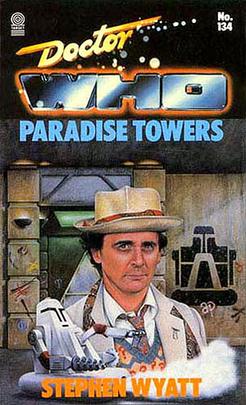 After an exhausting series of adventures, the 7th Doctor and
his companion Mel Bush decide to take a vacation. As any fan of Doctor Who in
particular or science fiction in general knows, this will not turn out well. All
Mel really wants is to spend a few days lounging by a swimming pool, and they
fly to the 22nd century's leading luxury apartment complex, Paradise Towers.
After an exhausting series of adventures, the 7th Doctor and
his companion Mel Bush decide to take a vacation. As any fan of Doctor Who in
particular or science fiction in general knows, this will not turn out well. All
Mel really wants is to spend a few days lounging by a swimming pool, and they
fly to the 22nd century's leading luxury apartment complex, Paradise Towers.
They find a building fallen into disrepair, and a divided
population. The Doctor and Mel are split
amidst a confusing situation, but they agree to meet back up at the rooftop
pool. There are roaming gangs of color-coordinated girls, with names like
"Bin Liner" and "Fire Escape." There are caretakers and female
residents, and robotic cleaners gone awry. The only free male in the complex is
Pex, the other men having fled to fight in a war. He appoints himself Mel's
protector, but is less than capable in the role.
In what is a pretty cliché plot at this point, the
artificial intelligence that runs the building has decided that the
"filthy human parasites" must be destroyed, as they have been the
cause for the building's fall into shabbiness. They discover that Kroagnon, the
original architect of the building never liked the idea of humans actually
living in any of his designs. Having killed the Chief Caretaker and animated
his corpse, Kroagnon uses booby traps in the building to declare war on its
human occupants.
But the divided people are brought together by the Doctor to
fight back against their less-than-human enemies. A sacrifice is made and victory
is achieved, ending the building's reign of terror. The outcome is predictable,
and none of the major guest characters are terribly memorable. Only Pex and Bin
Liner rise above the rest as individualized characters. Overall, there is very
little about this story that is other than ordinary.
The unabridged audio performance of this novelization was narrated
by Bonnie Langford, who played Mel in the TV series. She does a fine job
bringing energy to the story.
source: public library.
Saturday, March 16, 2013
Book #12
DC Comics Secret Origins, hardcover collection. Various writers and artists.
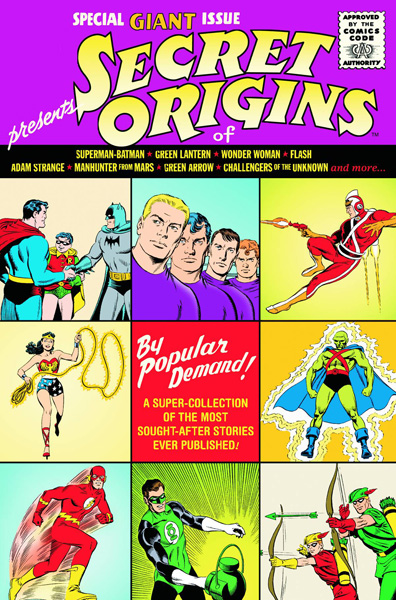 This is a reprint collections of reprint collections. The
hardcover contains 4, 80-page reprint collections originally published in 1961,
1965, 2003, and 2004. Most of the individual stories come from the "Silver
Age" of comics, the 1955-1965 era, although a pair were from 1940, and a
few came from as late as the early 1970s. This variety of dates gives readers the opportunity to note how drastically comics have changed over the decades, both in terms of the writing and art.
There is a very nice mix of characters included in this
volume, including Doctor Fate, Enchantress, Animal Man, and the villain Eclipso.
I quite enjoyed the more science-fiction stories involving Hawkman, the
Manhunter from Mars, and the very under-appreciated Adam Strange. This collection
also reminded me how much I like the Challengers of the Unknown, a team that
has never been able to find a foothold in modern versions of the DC Comics
universe.
 In addition to characters, there are a few
"origins" of other things, such as the Green Lantern oath and the
sidekick team of Jimmy Olsen and Robin. In
the early days of comic books, companies received favorable postage rates if
they included prose pieces, and there are two of these stories reproduced,
involving the war character Blackhawk, and the archer Green Arrow.
Some are actual firsts appearances of characters, while many
are stories that themselves recount in a flashback (or "clip show"
manner) a particular first appearance. That is the setup for the Justice League
story, with each character taking turns telling their part of the story that
served as the impetus for the league forming. The Superman origin is also a
later retelling of the origin from a book published in 1960, featuring his
departure as Superboy from his hometown of Smallville.
source: local library
Subscribe to:
Posts (Atom)