Thursday, March 14, 2013
Book Guys Goats Intro!

Tuesday, March 12, 2013
Book #11
The Gods of Mars, by Edgar Rice Burroughs. Nook / Unabridged audio.

Many years have passed (at least on Mars) since the last time John Carter appeared on the red planet. And when he does re-appear, it is in the once spot from which none may ever leave: the Valley Dor, representative of the afterlife on Barsoom.
Carter's old friend Tars Tarkas rescues him, and the pair then rescue the slave girl Thuvia. They are eventually recaptured, and Carter must appear before Issus, self-styled goddess of Mars. She communicates via secret means to the Therns, who consider this divine revelation. Carter is imprisoned, and he encounters a young man later identified as his son Carthoris. They lead a revolt, and return to Helium, where Carter is tried for heresy. It is discovered that his wife Deeja Thoris has made the pilgimage to Dor to find him. Carter again escapes and flees to rescue his beloved.
I enjoyed the action in this story, although there was a repetitive nature to it, a continual cycle of capture and escape, capture and escape. The new setting of the first half of the book helped, as through Carter's eyes, we were able to explore previously unknown parts of Mars.
I started this book on my Nook, but I moved to the audio version when I found it at my library. need to mention the excellent quality of William Dufris' narration. John Carter is a Virginian, a Civil War veteran, and it would have been easy for a narrator to overplay Carter's Southern heritage with a stereotypical deep South drawl. But Dufris wass able to capture the much lighter accent of the southern gentlemen, and that nuanced performance was a strength of the audio presentation.
Source: Project Gutenberg (Nook version) / public library (audio version).
Many years have passed (at least on Mars) since the last time John Carter appeared on the red planet. And when he does re-appear, it is in the once spot from which none may ever leave: the Valley Dor, representative of the afterlife on Barsoom.
Carter's old friend Tars Tarkas rescues him, and the pair then rescue the slave girl Thuvia. They are eventually recaptured, and Carter must appear before Issus, self-styled goddess of Mars. She communicates via secret means to the Therns, who consider this divine revelation. Carter is imprisoned, and he encounters a young man later identified as his son Carthoris. They lead a revolt, and return to Helium, where Carter is tried for heresy. It is discovered that his wife Deeja Thoris has made the pilgimage to Dor to find him. Carter again escapes and flees to rescue his beloved.
But even that victory is bittersweet, as Deeja is once again
taken, and placed in temple cage will cannot open for another full Martian
year. Adding to the melodrama of the cliffhanger, the jealous Thuvia has also
been captured, and the two women plunge daggers at each other as the door
closes, and the novel ends. All that John Carter hears as the doors shut is one
woman's death throes. But John Carter must wait a full year to discover who has
died: Deeja or Thuvia.
Fortunately, we can just read book #3 (The Warlord of Mars) to
find out.I enjoyed the action in this story, although there was a repetitive nature to it, a continual cycle of capture and escape, capture and escape. The new setting of the first half of the book helped, as through Carter's eyes, we were able to explore previously unknown parts of Mars.
I started this book on my Nook, but I moved to the audio version when I found it at my library. need to mention the excellent quality of William Dufris' narration. John Carter is a Virginian, a Civil War veteran, and it would have been easy for a narrator to overplay Carter's Southern heritage with a stereotypical deep South drawl. But Dufris wass able to capture the much lighter accent of the southern gentlemen, and that nuanced performance was a strength of the audio presentation.
Source: Project Gutenberg (Nook version) / public library (audio version).
Sunday, March 10, 2013
HAIL DOOM!
 I was recently invited to be a guest-host on the excellent Fantasticast podcast. We discussed the terrific Fantastic Four annual from 1964, featuring many stories of my favorite comic book character, the sorely misunderstood Doctor Doom. I take the lead in presenting my synopsis of the intro story, the excellent "Origin of Doctor Doom," and then join in with the discussion of the extra-long adventure, "The Final Victory of Doctor Doom."
Andy and Steve were kindly hosts to me, and after speaking with them for just over 2 hours, I am beginning to think that those British accents may not be fake, after all.
The episode is #34 of the Fantasticast, and can be found via iTunes or directly from the show's website.
Friday, March 8, 2013
Book #10
Craving Grace, by Lisa Velthouse. Hardcover.
Lisa Velthouse grew up trying to be the "perfect
Christian girl" -- no drinking, no cursing, and always paying attention to
her parents. She even wrote a book about her choice to not kiss until her
engagement, 2003's Saving My First Kiss, which allowed her to begin a
career of speaking at conferences and writing on church staffs. Everything
about her life revolved around earning God's approval. And she was convinced
that she had done that.
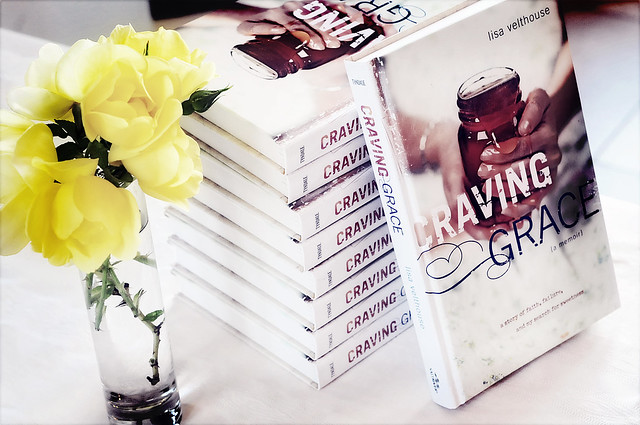 And then a few years later, at a sister's wedding, she broke
the no-kissing vow. Convinced that she had lost God's favor, she spent years
studying, seeking after, (and receiving) undeserved grace, both from God and
from people. Craving Grace is her recounting of that search.
There are many Christian living books where the author will
use occasional examples from their life to amplify their theological point. But
I prefer books like this, where the author uses the memoir form to tell a very
personal story, while also focusing on a particular aspect of faith or theology.
Readers of Lauren Winner's books will recognize this format. Velthouse uses the
recurring motifs of sheep and honey to tell her story, and her ability to
return to these themes, and to continually elaborate upon them, demonstrates
her skill as a writer.
The transparency and vulnerability that Velthouse shows in
telling this personal story is impressive. She is able to bring the reader
inside her head, and inside her heart, as she talks about her struggles to
understand the nature of living in a Grace that is wholly underserved. One
subplot in the story is her attempt to fast from sweets for a period of time.
It was just good fortune that I read this book over Lent, but that added nicely
to my own experience of the book.
The memoir portions of the book are not told
chronologically, and this "jumping around" in time (the events of the
book cover a three-year period) may be disconcerting to a reader who is used to
reading a book like this in order. But that is a minor quibble; the book is
excellent.
Wednesday, March 6, 2013
Retro-Review: The Fighting American
The Fighting American, issues 5-7+, 1954, 1955, & 1966.
by Joe Simon & Jack Kirby.
 In the aftermath of the 1954 anti-comic hearings before the US
Senate, EC Comics collapsed, which contributed to the collapse of Leaders, the
distributor for Joe Simon and Jack Kirby's The Fighting American.
Without distribution and with comics sales collapsing all across the industry,
their publisher was forced out of business after publishing 7 issues of the comic.
Harvey Comics brought out another issue in 1966 in an attempt to revive the
title, but that effort failed. All of these issues, and a single story that
would have been in Harvey's issue 2, are included in the Simon & Kirby Superheroeshardcover collection.
Note: Issues 1-4 were discussed here.
 In the aftermath of the 1954 anti-comic hearings before the US
Senate, EC Comics collapsed, which contributed to the collapse of Leaders, the
distributor for Joe Simon and Jack Kirby's The Fighting American.
Without distribution and with comics sales collapsing all across the industry,
their publisher was forced out of business after publishing 7 issues of the comic.
Harvey Comics brought out another issue in 1966 in an attempt to revive the
title, but that effort failed. All of these issues, and a single story that
would have been in Harvey's issue 2, are included in the Simon & Kirby Superheroeshardcover collection.
The strengths of these stories is the humor that Simon
brings to them. It seems that by this point, he and Kirby had decided to make
these tales as over-the-top as possible. Every issue contains at least one
laugh-out-loud moment, and usually every story does. There are crazy situations
and characters for Kirby to draw, including Invisible Irving, the alien
shape-shifter Space-Face, and the Martian Gulnik.

The Fighting American and Speedboy become world travelers in
these issues, chasing Jiseppi the Jungle Boy in India, fighting over oil in the
Middle East, and stopping an evil movie production in Italy.
The last story (unfortunately unpublished) tells a surreal
post-modern story in which the artist of the Fighting American comics has been
driven crazy, announcing that he is "through getting my kicks on a drawing
board! I'll live my own life of adventure ... and I'll beat Fighting American
at his own game!" The extent to which this is Kirby's own thoughts about
the comic industry (or Simon's) is unknown, but it is a fascinatingly weird
tale.
These stories show that by this part of their careers, Simon
and Kirby had come into their own as elite comic book professionals.
Source: public library.Note: Issues 1-4 were discussed here.
Tuesday, March 5, 2013
Podcast Marathon
 Monday was the first day of Spring Break, and there was not much on the DVR, so I powered through many, many podcasts. Here is what I listened to yesterday:
No Agenda, episode #492. I listened to some of this via the live stream on Sunday, but filled in the rest this morning. Alternative news and media analysis from veteran tech columnist John C. Dvorak and "podfather" Adam Curry.
Alison Rosen is Your New Best Friend. In this episode, Alison talks to actress Jenny Mollen about relationships, work, and being married to Jason Biggs.
Back to the Bins, episode #101. Scott Gardner, Paul Spataro, and Bill Robinson talk about old comic books. This is quickly becoming one of my absolute favorite comic book podcasts. The vibe between the hosts is great.
Adam Carolla Show. Adam and crew talk with singer Lisa Loeb, and talk about the news of the day.
Writing Excuses. A 20-minute episode in which the crew helps Dan work on an idea for his next novel project.
Fire & Water Podcast, episode #45. Comic-book bloggers Rob Kelly and The Irredeemable Shag talk about Aquaman 17, Firestorm 17, and Justice League 17.
Saturday, March 2, 2013
Revisiting Holmes: The Second Novel

Book 9. The Sign of Four, by Sir Arthur Conan Doyle.
Unabridged audio.
First published in1890, this is the second novel to feature
Sherlock Holmes. It is a much more enjoyable read than A Study in Scarlet,
which despite its historical value, gets bogged down for a long stretch. Although
the revenge plot is similar to that in the first novel, this story moves a very
nice pace, and both the plot elements and character beats are strong.
This book contains much of what a Holmesian mystery should contain.
It has more of a historical fiction feel to it, with all of the action is
confined to London. Holmes is in his element in this locale, whether he and
Watson are using a dog to track a man through the streets of London, or the
irregulars are scouring the ports for a very particular boat, or he is jousting
with detective Athelney Jones.
The detective is hired by a beautiful young governess, Mary
Morstan, to solve the mystery of the single pearl she receives every year on
the anniversary of her father's death. Holmes
reveals the complex plot, which involves a pact of four convicts and a pair of
corrupt prison guards to smuggle a treasure out of India. After the case is
solved, Watson proposes marriage to Mary, and the two wed.
The novel starts and ends with Holmes' cocaine use. This
adds characterization to both Holmes and Watson, in his reaction to his
friend's addiction. There is also a nice sense of symmetry here, by beginning
and ending the story in the same fashion.
The very end of the novel is typical Holmes, with Watson
asking what the great detective has gotten out of his involvement in the case.
Holmes did all the work, while Watson found a wife, and Jones has received credit
for the arrest.
Subscribe to:
Posts (Atom)